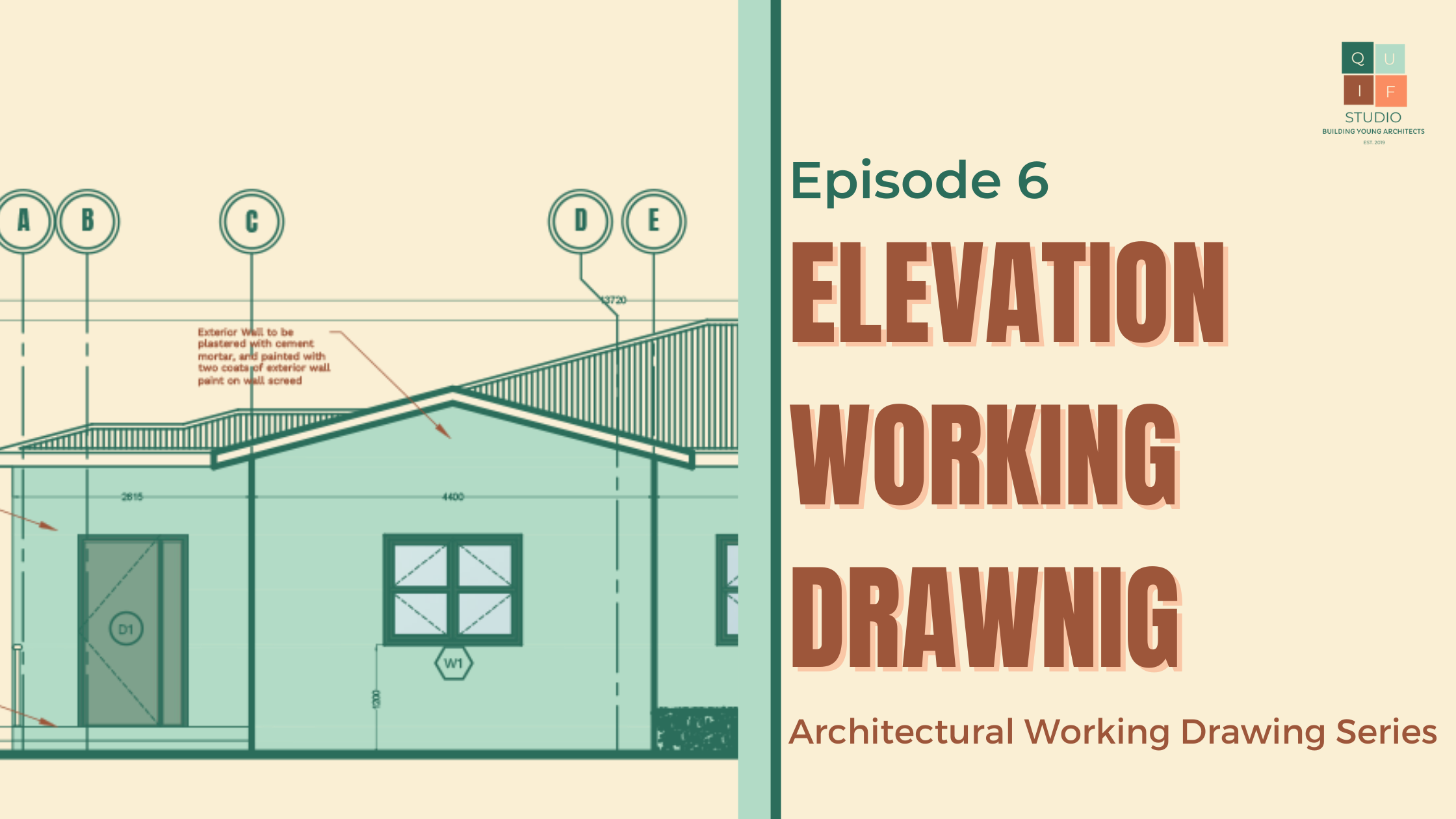
Elevation working drawings, like their counterparts in floor plans and section drawings, serve as an indispensable guide in the realm of architecture and construction. These drawings offer a vertical perspective on a building’s façade, encapsulating the very essence of its external appearance. Just as floor plans provide insight into the layout of a structure, section drawings unravel its inner workings, elevation working drawings reveal the outward face that meets the world. These drawings not only convey the aesthetic design elements but also provide critical information about materials, proportions, and architectural details.
In this post, you will learn the information conveyed in these drawings, while also gaining invaluable insights into their critical role in the construction of buildings. Given that most information has been covered in previous drawings, the required information for elevations are as follows:
- Indicate levels of all floors, ceiling, parapet and assumed ground level.
- Indicate finishing to all surfaces.
- Indicate fixed and open-able parts of all doors and windows.
- Dimensions and sizes of all façade elements.
- Provide grid lines.
- Indicate areas (if any) where further details are provided in subsequent drawings or by other consultants or manufacturers.
Graphics of Elevation Working Drawing
- Scale
Similar to sections, the scale for an elevation working drawing, should be large enough to expose details of the drawing. 1:50 can be adopted for relatively smaller buildings, while 1:100 can be adopted for larger buildings. However, it is necessary to blow out certain parts of the elevational drawing to a bigger scale to reveal more information.
- Dimensions
All parts of the drawing should be fully dimensioned; however, repetition should be avoided to prevent confusion. Dimensions should be accurate and legible.
- Symbols and Annotations
Symbols and annotations can be adopted from previous drawings and used where necessary.
- Specifications
Materials and finishings should be fully specified in the drawing. This information can be provided in the drawing, in schedules or in the specification document of the project.
Elevation working drawings are the visual blueprints of a building’s external charm. Offering insights into design elements and material choices, these drawings play a pivotal role in bridging architectural concepts with tangible structures. This post aimed to highlight their significance, empowering you to navigate the intricacies of elevational design with precision and flair.
To have access to a complete checklist of information to be provided, you can click the download button below:
